Source Systems
WMS · Oracle · APIs
LaborAI Middleware
Data Layer
Intelligence

Connected Labor Intelligence
Connect LaborAI to the systems you already use and turn real operational data into a precise, day-ahead labor plan.
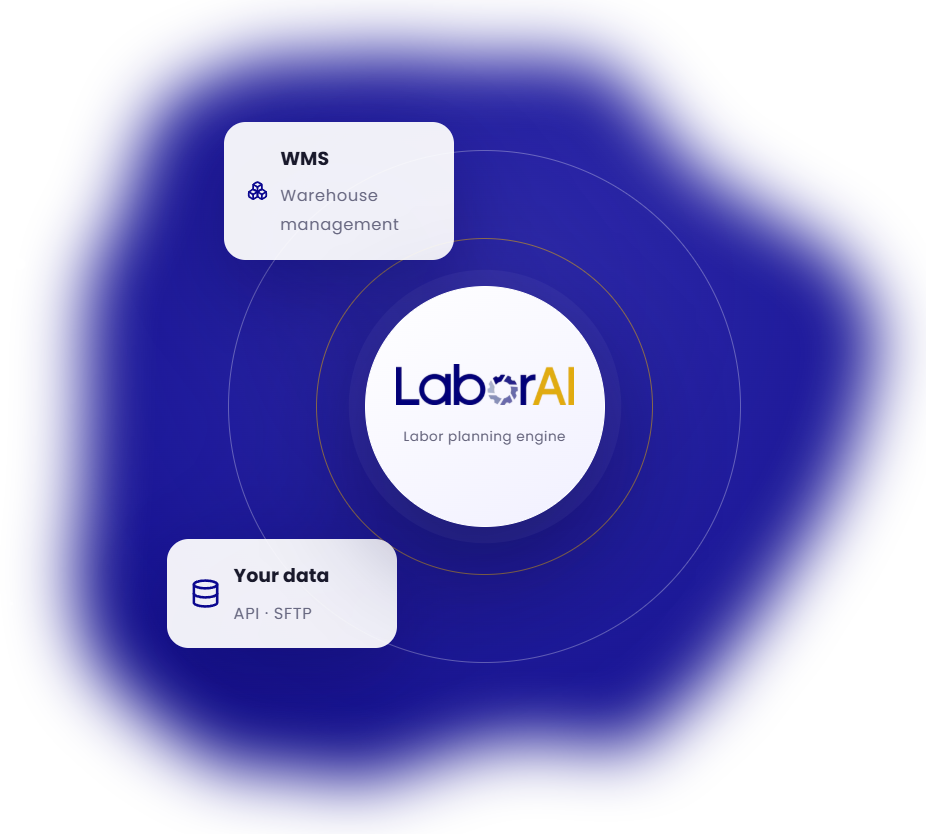
Integration ecosystem
LaborAI Enterprise sits above your existing technology stack, turning operational data into a forward-looking labor plan without forcing your team to replace the systems that already run the operation.
LaborAI can integrate with leading platforms including Softeon, NetSuite, Manhattan, Made4net and Blue Yonder. Our flexible middleware supports both API-driven and direct-database workflows, allowing operational data to move securely into LaborAI Enterprise for automated labor planning, forecasting and performance visibility.
The architecture is system-agnostic. LaborAI can connect with virtually any other commercial WMS, as well as proprietary or in-house warehouse management systems, using the integration method that best fits the customer’s environment.
Enterprise Integration Architecture
A flexible, system-agnostic foundation for modern and legacy warehouse environments.
LaborAI Enterprise utilizes bespoke middleware architecture to integrate with existing Warehouse Management Systems (WMS), supporting both direct-database ETL and API-driven workflows.
Raw transactional data can be directly extracted from a source database on a set or custom schedule, where it is then processed to aggregate specific operational metrics.
To support modern, decoupled environments, the middleware also provides on-demand data synchronization, paginated endpoints serving normalized dimensional data such as items, inventory and shipments, and a built-in machine learning module designed to dynamically calculate and label inventory stockout risks.
Source Systems
WMS · Oracle · APIs
LaborAI Middleware
Data Layer
Intelligence
From Operational Data to Daily Action
LaborAI adds a planning layer to your existing technology. No rip-and-replace. No parallel operating system.
01 · Connect
Securely read the operational variables that actually drive labor.
02 · Model
Evaluate work mix, operating conditions and expected productivity by function.
03 · Plan
See required hours, skill needs and risks early enough to adjust staffing.
1,184 planned hours